
How Much Can Insulation Save?

Saving money is something every homeowner can relate to, and fortunately, there are lot of simple ways to cut costs! Insulation tops that list, offering both energy savings and increased comfort all year long.

But how much does insulation save you? It’s a question many homeowners have. Although exact estimates are difficult to make since a number of different factors have an impact, there are some tools online that can help you figure out approximately how much you can save by insulating your home.

Calculating Savings

You can visit CIMA (Cellulose Insulation Manufacturers Association) online to calculate insulation savings. You can measure the financial impact of increasing your insulation performance by entering your data into the insulation calculator—the size of your house, the cost of your energy, etc. With the calculator, you can see what you would be saving this year and in the future!

Here’s another home energy saver tool. It calculates all your energy bills using your current rates and personal information, such as where you live, the number of your household members, what year your home was built, whether you have a basement or not, the type of HVAC system you have, etc. After filling in your data, you’ll get back your current yearly energy costs and how much you can potentially save with upgrades.

Tips for Maximizing Insulation Savings

There are some things you can do to make sure you get the most out of your insulation. We recommend:

  • Talking to a reputable insulation company: DIY insulation projects are not recommended. It’s best to talk to insulation professionals, who can ensure you not only are using the right material but that you’re also getting the right amount of insulation and insulating the appropriate areas of your home to gain the most energy savings.
  • Properly air sealing your home: Air sealing and insulation go hand in hand. A home that is properly insulated but not air sealed isn’t energy-efficient. Air leaks reduce the effectiveness of your insulation, so your home really needs to be both insulated and sealed. Energy audits are a great way to tell where your home needs to be both insulated and sealed for the highest energy efficiency.
  • Making sure other areas of your home aren’t hindering your energy efficiency efforts: You won’t be saving as much money as you could if your home is insulated but isn’t energy-efficient in other ways. For example, if your windows are old and leaky, you leave your fireplace flue damper open when not in use, your home still has energy-inefficient incandescent bulbs instead of CFL bulbs, etc., there is a lot of potential for savings. There are a lot of ways to save energy (and money)—and combined with bigger ticket items like insulation and window replacement, they can help gain significant annual energy savings.

Get Your Insulation Project Estimate!

So the question, “How much does insulation save?” doesn’t have a quick, one-solution-fits-all answer—it depends on many factors (where you live, the age of your home, etc.). But it’s easy enough to find out with online tools. Talking to a professional insulation company is the best course of action!

If you live in Nashville or a surrounding area, make us your first call! We’ve installed insulation for many homes and businesses and look forward to helping you too. Contact Installed Building Products of Nashville for a free estimate, or call us at (615) 244-9420!
Insulation R-Value Guide

When it comes, to insulation, you may have heard R-value thrown around a lot. R-value is important when choosing insulation, but it can be confusing at first. Keep reading to learn what exactly R-value is and what it means for your insulation.

What is R-Value?

R-value is the measurement of heat flow resistance, which essentially comes down to how effectively insulation performs. This heat resistance value, or “R-value”, is important to know when considering insulation for your home or commercial property. After all, insulation’s job is to help stop heat flow, so you want to make sure you’re getting the proper R-value for your home or building.

Need insulation in your home or commercial property? Contact Installed Building Products of Nashville today to get an estimate for insulation installation!

How Is Insulation R-Value Calculated?

A material’s R-value is also calculated per inch of width. For example, solid wood has an R-value of 1. Therefore, a three-inch-thick board has an R-value of 3. Blown-in fiberglass installed in an attic has an R-value of 2.2 per inch, so 12 inches of it would give you an R-value of 26.4 in your attic installation project.

What R-Value Is Best for My Home?

A higher R-value generally makes for a more effective insulator, but the highest R-value possible may not necessarily be right for your project. Depending on the climate, the amount and R-value homes and buildings need can vary.

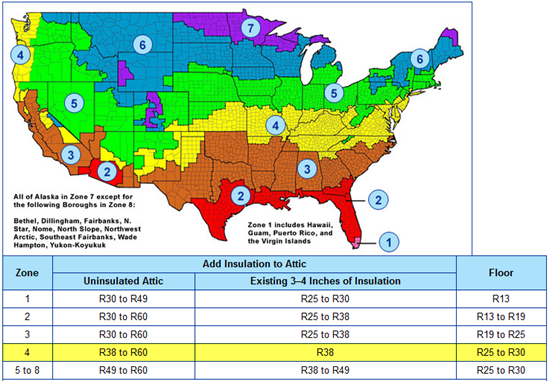
For example, homeowners in Alaska don’t need to worry about insulating against extremely warm temperatures, but its weather is quite different from Tennessee’s. Due to varying weather patterns, the United States is divided into insulation zones with different recommended R-values per zone.

Insulation zones are determined by region, and here in the Nashville area, we are in Zone 4. In this zone, the recommended insulation R-value ranges from R30 to R60 depending on where in your home or building the insulation is installed.

Insulation Climate Zones

Source: energystar.gov

Where Do I Need Insulation in My Home?

Where to install insulation is the second thing you’ll need to know because different areas of your home or building require different R-values. Your home’s attic needs a higher R-value than your walls because heat naturally rises and commonly escapes through your attic.

Different materials also differ in R-values. For example, spray foam insulation has a different R-value than fiberglass insulation.

After you’ve figured out your zone and where your insulation is going to go, then you can consider your options for which type of home insulation will be best.

Need help determining where to insulate in your home or building? Call IBP of Nashville today at (615) 244-9420!

Choosing the Right Insulation

The R-value shouldn’t be the only determining factor when you choose insulation. Some factors that can play a part in choosing the right type of insulation and amount of insulation are:

  • How old your home or building is
  • Your home or property’s location
  • Building materials used during construction
  • Cost of insulation materials and your budget
  • The needs of the inhabitants of your home or occupants of your building

This is a lot of information, but no need to worry—you don’t have to do this on your own! An insulation company will be able to help you with all your needs and explain R-value, the right amount of insulation for your home and more.

Need Insulation in Your Nashville Area Home?

No matter what material you choose for your project, look no further than Installed Building Products of Nashville. Never ask, “Where can I find insulation contractors near me?” again!

If you’re in the Nashville area, contact IBP of Nashville to learn more about our insulation installation services or if you’re ready to install insulation in your home!

Vapor Barriers for Crawl Spaces

Does your home have a crawl space? If so, it should be insulated and weatherized—otherwise, your home can experience energy efficiency issues. And every homeowner wants to save money!

If you’ve been researching crawl space insulation or have been talking to any professionals, you’ve probably seen or heard about vapor barriers. To be as energy-efficient as possible and to better protect living areas of the home, a crawl space should have a vapor barrier.

Why Do Crawl Spaces Need a Vapor Barrier?

The type of crawl space—ventilated or unventilated—will help determine the insulation material and method that should be used. But for further protection, a vapor barrier is ideal. A polyurethane vapor barrier can be installed over the dirt and covered with sand for protection. The barrier should cover the entire floor and be secured along the perimeter of the wall. This helps reduce moisture in the crawl space. Basically, the space should be enclosed in a thermal envelope.

For such a small area, a crawl space can have a big huge impact on your home’s energy efficiency. No matter what type of crawl space you have and what material you use, you’ll notice the difference proper insulation—including vapor barrier installation—can make. It can help:

  • Maximize the energy efficiency of your home
  • Make your home more comfortable all year long
  • Improve the performance and efficiency of your HVAC systems
  • Contribute to a healthier environment

Crawl Space Vapor Barrier Installation in the Nashville Area

When you need home insulation services in the Nashville, Tennessee area, our team is the team to call. Installed Building Products of Nashville installs crawl space insulation and can ensure your entire home is as energy-efficient as possible. Contact us today!